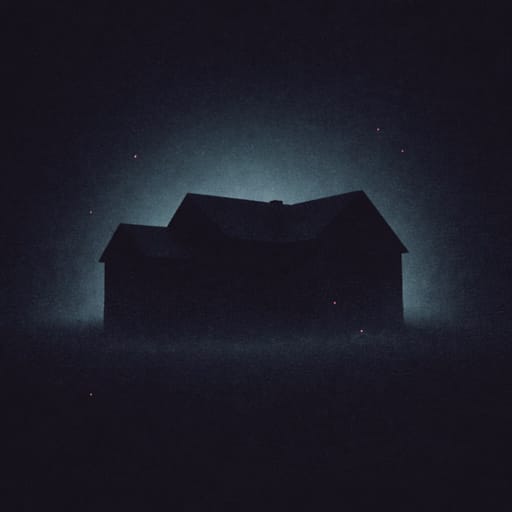
Svenskhuset
BasertPåFakta Historisk Mystisk
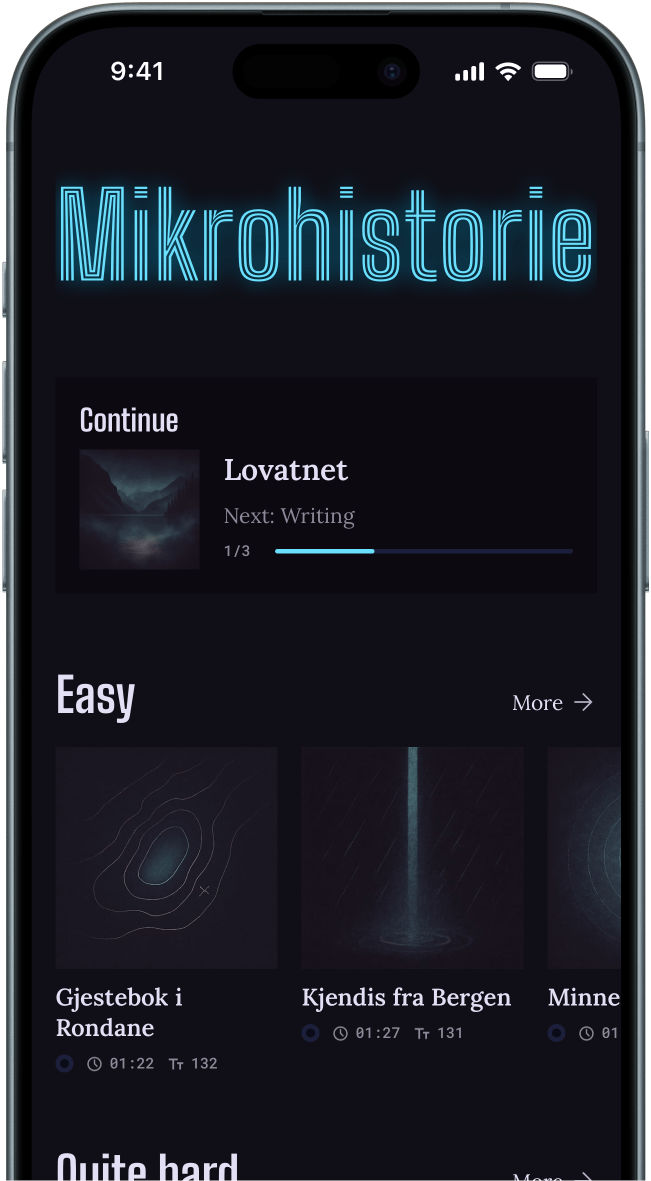
Mikrohistorie helps you learn to understand Norwegians on your own. 20 minutes a day is enough to build pronunciation, vocabulary, and listening comprehension.


Well organized and good way to learn.
This is a normal stage of learning, and we can help you get through it.
In Norway there is no single spoken standard that everyone uses. Each region has its own dialect, and for many Norwegians it is an important part of identity.
In everyday life, Norwegians speak quickly, shorten words, and sound different depending on where they come from.
That is why you can do well with texts and still get lost in conversation.
The answer is not another textbook, but regular contact with spoken Norwegian. In Mikrohistorie, you learn to understand on your own terms, at your own pace, and without judgement.
Mikrohistorie is recorded by Norwegians from different parts of the country. This helps you get used to the language you will actually meet at work, in shops, on the street, with neighbours, and in conversations with friends. You learn to understand people.
Listen to an example sentence in different dialects:
Hun aner ikke hvor de skal.
(She has no idea where they are going.)
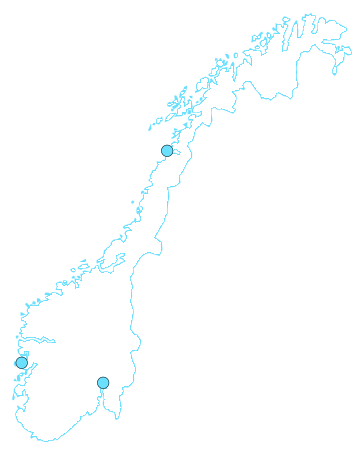 Bodø
Bergen
Oslo
Bodø
Bergen
Oslo
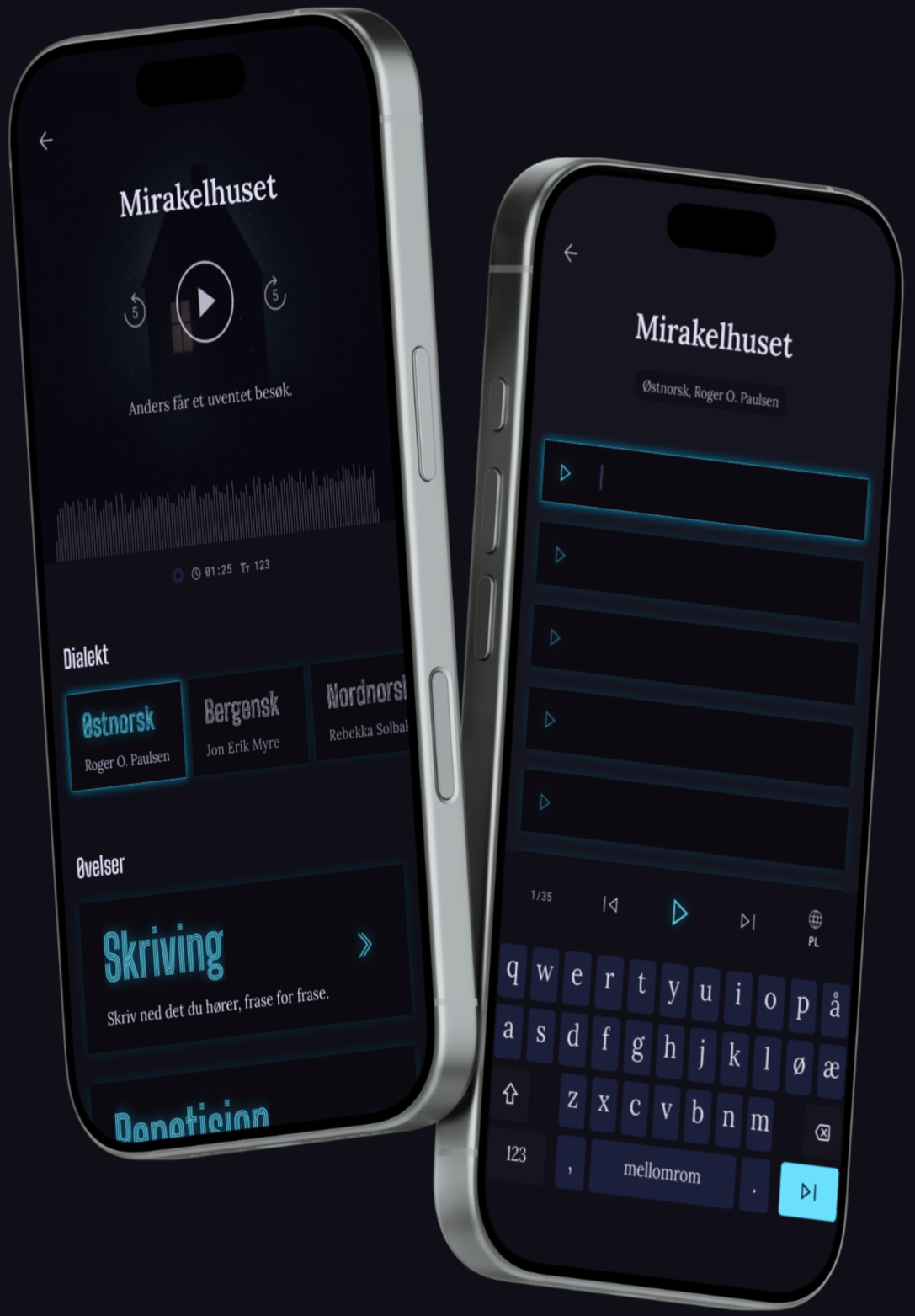
Every story follows the same simple cycle. First you listen. Then you write down what you hear. Then you repeat it out loud. At the end, you compare the same text in another dialect.
Start by choosing one micro-story to focus on. Listen to it from beginning to end with full attention.
In the app, stories are divided into short phrases. Listen to each phrase as many times as you need. Write down what you hear, even if you are not completely sure.
After writing the whole story, you can check how you did.
Listen closely to each phrase and repeat it out loud. This way you practise pronunciation and the rhythm of the language, not only comprehension.
Listen to the same story in another dialect. Once you know the content, you can clearly hear what changes, and that is when dialects start to feel less foreign.

You will find crime stories, documentaries and stories inspired by real events, science fiction, and light family adventures. These are short stories you will want to return to. Before you know it, you will have worked through as much material as in a substantial textbook.
BasertPåFakta Historisk Mystisk
BasertPåFakta Yrke Hverdag
Fiksjon Hverdag Natur
Fiksjon Historisk
Fiksjon Natur
Fiksjon Natur Mystisk
Fiksjon Hverdag
BasertPåFakta Historisk Mystisk
Fiksjon Krim
Fiksjon Familie Natur
Fiksjon Natur
Fiksjon Yrke Mystisk
BasertPåFakta Natur Historisk
BasertPåFakta Yrke
Fiksjon Mystisk Krim
We wrote and collected these stories over several years. Each one was created so that its grammar and vocabulary fit one of three difficulty levels. They were proofread by Jan Roger Stensland, whom we have worked with for many years.
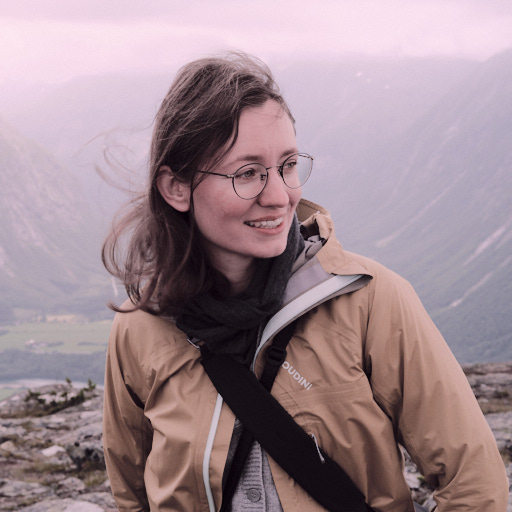
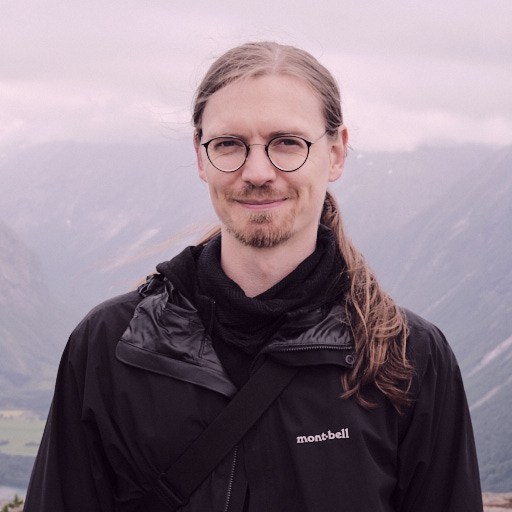
For 10 years, we ran Norwegian language workshops and pronunciation training in Oslo. That is where participants told us that two things cause the greatest difficulty when learning Norwegian.
The first is grammar. That is why we wrote Anatomia norweskiego, a book that has already helped thousands of people organize their Norwegian grammar.
The second is pronunciation and dialects. Many people work every day with Norwegians from different regions: Bergen, Kristiansand, or the north.
Mikrohistorie is the first app that teaches pronunciation in a dialect of your choice. You practise writing what you hear, which helps you learn pronunciation and grammar and better understand spoken Norwegian.
Mikrohistorie is for people who want structured work with real spoken Norwegian.
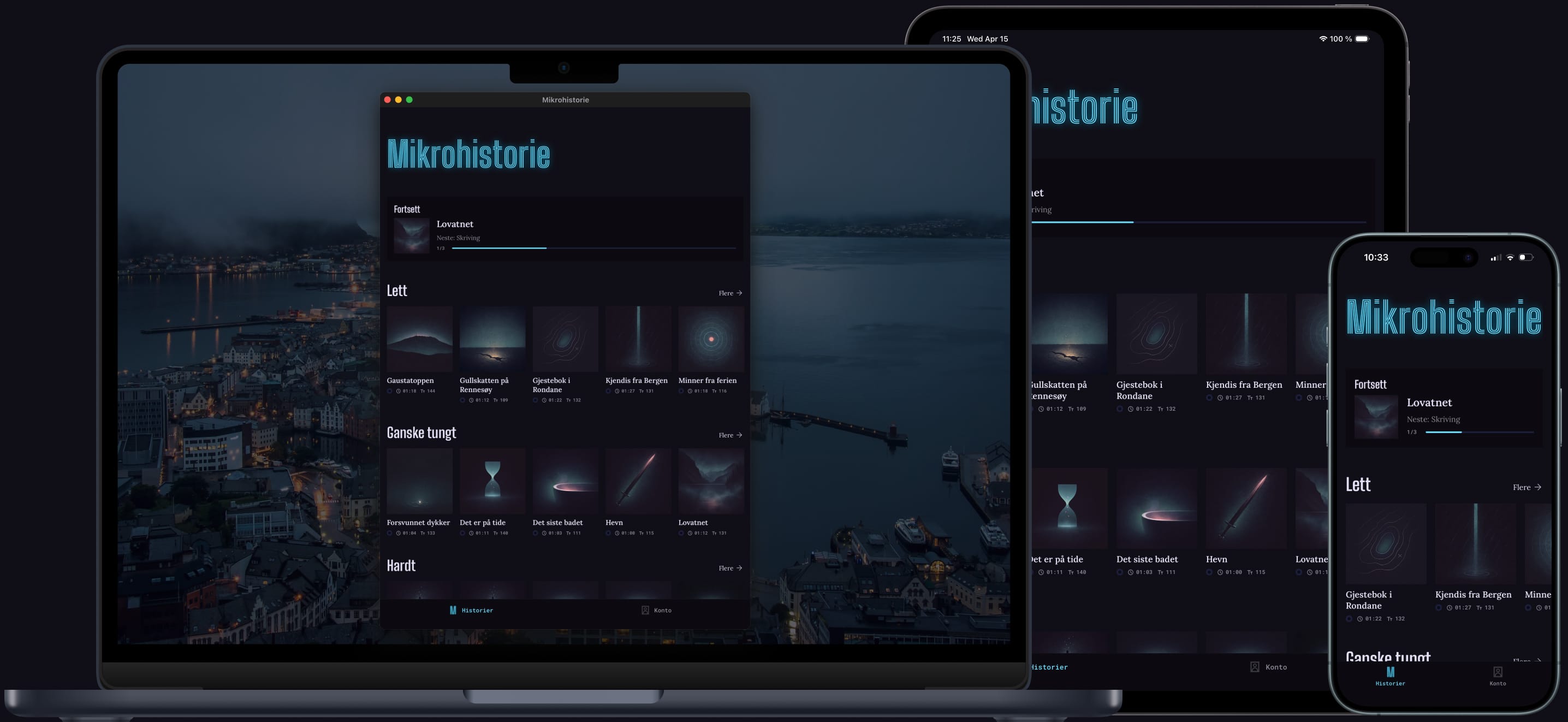
For adults who already know some Norwegian and need more contact with spoken language. If you can read a simple text but get lost when someone speaks, this app works directly with that difficulty.
You do not need to know dialects to start. Basic Norwegian, roughly from A2, is enough. Every story has a translation, so you can always check whether you understood correctly.
Yes. Every story is translated into Polish and English.
All stories are recorded in østnorsk (the Oslo region). Some are also available in bergensk, nordnorsk, and sørlandsk. We are working on more dialects depending on interest.
The app is free to download and you can try it without paying. A monthly or yearly subscription gives access to all stories and exercises.